
DOE / NAWI Pilot Program

NAWI Mobile Pilot

California

DOE's National Alliance for Water Innovation selected a Global Water Innovations-led team, with Trevi Systems as project partner, to demonstrate high-recovery desalination at five California sites with one transportable unit.

Program Snapshot · Five-Site Objective

One Treatment Train, Many Waters

The mobile testbed pairs scale-ion removal with brine concentration at five California sites: Cambria, San Luis Obispo, Oxnard, Ventura County, and South Beach County.

Trevi's 25 m³/day FO/PFO mobile unit handles varied RO brines, including agricultural and oil-and-gas wastewater feeds.

Lead selectee
Global Water Innovations
Trevi role
Project partner
Site objective
Five California locations
Published scale
25 m³/day · Trevi-reported

Field results from all five demonstrations are peer-reviewed (Webley, Greene & Easter, AJRSP, 2026).

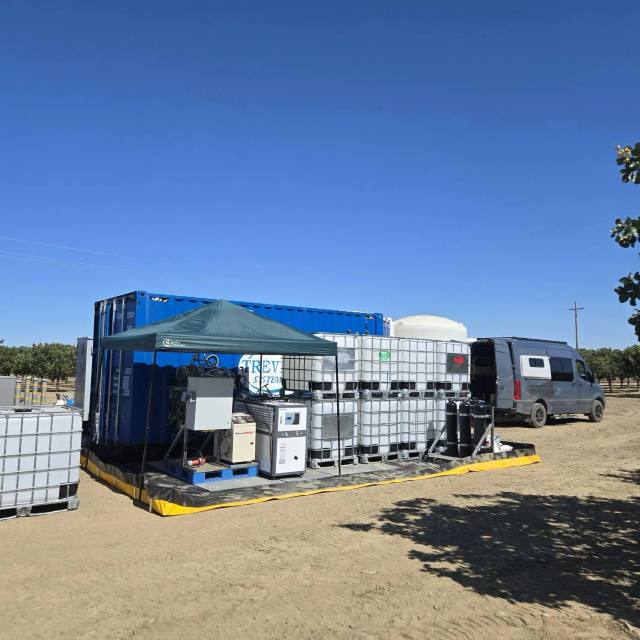
Trevi mobile water-treatment testbed in California
Trevi mobile water-treatment equipment beside a California orchard
Mobile Qualification · Source Water to Source Water

Why the Testbed Travels

A transportable train lets the team characterize each feed and evaluate the complete system at the water source.

  1. 01

    Municipal concentrate

    Scaling risk and residual routes begin with the existing treatment train.

  2. 02

    Agricultural water

    Salinity and scale-forming ions vary with source and season.

  3. 03

    Industrial streams

    Oil-and-gas wastewater is among the intended mobile-unit applications.

Request a Feed Review
Integrated Train · Five Decisions

Treating the Water on Site

The program combines scale-ion removal with brine concentration in one integrated train.

  1. 01

    Characterize

    Measure flow, salinity, hardness, silica, organics, temperature, and variability.

  2. 02

    Remove scale formers

    Tune upstream softening for the ions that limit membrane recovery.

  3. 03

    Concentrate

    Apply Trevi PFO and monitor the concentrate as conditions change.

  4. 04

    Polish and route

    Finish recovered water to specification and define the residual outlet.

  5. 05

    Validate the train

    Record performance across conditioning, PFO, polishing, and residual handling.

Published Source · Cambria CSD · March 2026

Reading the Published Results

Cambria CSD · March 2026

Integrated treatment-train result

Cambria CSD describes a five-site program in which Trevi PFO followed alternative upstream softening approaches.

PublishedProgram objective
Five California sites
Cambria CSD
PublishedUpstream treatment
Two alternative softening paths evaluated before PFO
Cambria CSD
AttributedFinal brine range
100,000–150,000 ppm across the integrated pilot trains
Cambria CSD

The range describes integrated, site-specific treatment trains; it does not establish standalone-PFO performance or guarantee another feed's result.

AJRSP · 2026 · Peer-reviewed

Published field results across the five sites

Webley, Greene & Easter compare switchable-solvent softening against electro-membrane concentration across the five California pilot demonstrations in the Academic Journal of Research and Scientific Publishing.

PublishedWater recovery
84.2–98.4% across the five demonstrations
AJRSP 2026
PublishedCitation
Vol. 8 · Issue 86 · DOI 10.52132/Ajrsp.e.2026.86.1
AJRSP 2026

Results belong to the integrated treatment trains and feeds reported in the paper; they do not guarantee another site's performance.

Discuss Your Feed
Feed Review · Chemistry · Flow · Existing Train · Target

Start with the water at your site. Define the next test from the data.

California NAWI Mobile Testbed | Trevi Systems