
Brine Concentration
& managementSaltVault™ is Trevi's brine-concentration platform: electrochemical softening followed by pressurized forward osmosis, pulling water out of concentrated feeds toward minimal liquid discharge, or preparing a smaller stream for the final stages of a zero-liquid-discharge train.
MLD and ZLD Discharge Targets
Minimal liquid discharge recovers water and leaves a smaller stream to reuse, treat, or discharge under permit. Zero liquid discharge goes further: no routine liquid effluent, with a defined path for salts and solids.
FO or PFO serves as the concentration stage; the site's chemistry, recovery target, and residual outlet determine whether the project stops at MLD or continues through a thermal finisher, crystallizer, and solids handling.
- MLD target
- Recover water and substantially reduce the remaining liquid volume
- ZLD target
- Eliminate routine liquid effluent across the complete treatment train
- Candidate feeds
- RO concentrate · Mine water · Industrial residuals
- Design basis
- Chemistry · Flow · Temperature · Heat · Scaling risk · Residual outlet
Recovery, operating pressure, energy use, and economics are set from the feed analysis and complete process design.
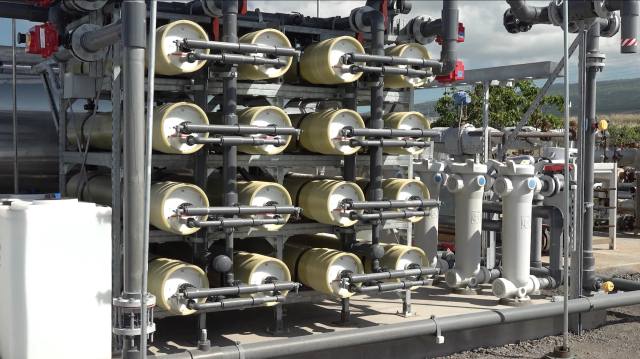
The SaltVault™ Concentration Core
At the center of SaltVault™, electrochemical (EDM) softening is paired with pressurized forward osmosis. Softening removes the hardness that otherwise sets the scaling ceiling, without the lime, sludge, and handling a conventional softening train requires. PFO then concentrates the softened stream well past the point where reverse osmosis stalls.
This stage does not run on low-grade heat and does not use thermally regenerated forward osmosis. That distinguishes it from Trevi's heat-driven FO desalination platform. Its job is to soften and concentrate a stream so that water recovery, mineral extraction, and residual handling downstream become economic.
- 01
Soften before you concentrate
Electrochemical softening strips the hardness that limits recovery, replacing lime softening and the sludge stream that comes with it.
- 02
Extend the membrane concentration range
Evaluate PFO after conventional membrane recovery becomes constrained by salinity, pressure, or scaling. It is not a universal replacement for every upstream step.
- 03
Reduce the downstream volume
Every unit of water recovered before thermal finishing leaves less liquid for an evaporator, crystallizer, pond, truck, or permitted discharge to manage.
- 04
Engineer around the chemistry
Hardness, silica, organics, temperature, and saturation limits determine conditioning, staging, cleaning, and the achievable concentration endpoint.
Five Technologies in One Flowsheet
Around that concentration core, SaltVault™ is assembled as a rapidly deployable, highly tailored brine-processing train. It concentrates hyper-saline streams and makes critical-mineral recovery from waste brines economical. Five technologies are selected and sized against the feed chemistry and the discharge target.
- 01 · Pre-treatment
- Tailored ceramic membrane pre-treatment
- 02 · Oxidation
- Advanced electro-oxidation (AOP)
- 03 · Scaling-ion control
- Selective electro-dialysis metathesis (EDM)
- 04 · Post-treatment
- Finished water to boiler make-up or drinking-water specification
- 05 · Residuals
- Advanced mineral separation and ZLD options
Field basis: the five-site NAWI program in California and its peer-reviewed test report (AJRSP, 2026).
Five Steps From Assay to Residual Plan
Set the endpoint first, then design pretreatment, concentration, finishing, and residual handling around the feed.
- 01
Characterize
We characterize feed and projected concentrate chemistry across the full recovery curve. Scaling risk is set by how counter-ions behave as recovery climbs, not by the starting feed alone.
- 02
Set the target
Define the required water recovery and residual outlet. MLD and ZLD are operating and permitting outcomes, not labels.
- 03
Condition
Select pretreatment, softening, pH control, filtration, and cleaning strategy from the chemistry and the intended concentration factor.
- 04
Concentrate
Stage FO or PFO to recover water within the membrane, pressure, heat, and saturation limits of the design basis.
- 05
Finish or manage
For MLD, route the residual to its approved outlet. For ZLD, continue through thermal finishing, crystallization, and solids management.
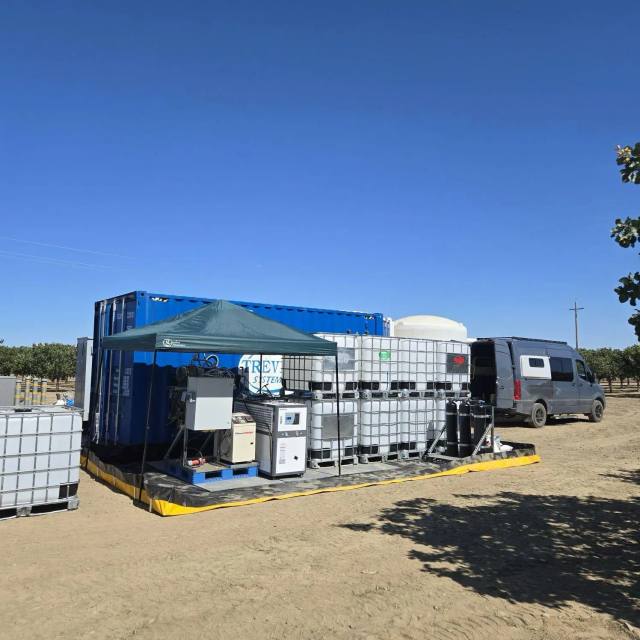
Documented Brine Reference Projects
A California Energy Commission program was completed at the Orange County Water District, where Trevi tested a 50 m³/day FO system to evaluate additional water recovery from RO concentrate and reduce the remaining brine volume. Separately, NAWI selected Global Water Innovations and Trevi for a 25 m³/day mobile FO/PFO platform run across five California sites (Cambria, San Luis Obispo, Oxnard, Ventura County, and South Beach County), concentrating reverse-osmosis brine and other nontraditional streams toward near-zero liquid discharge. The program's comparative field results are published in a peer-reviewed paper (Webley, Greene & Easter, AJRSP, 2026).
- $1.7 million
- California Energy Commission funding for Trevi's Orange County program
- 25 m³/day
- Capacity of the NAWI mobile FO/PFO platform, run across five California sites
- 84.2–98.4%
- Water recovery reported across the five pilot demonstrations in the peer-reviewed AJRSP (2026) paper
These projects establish relevant pilot and demonstration experience. They do not establish a universal recovery, final salinity, energy use, operating pressure, or ZLD endpoint for another feed.
Request a Brine AssessmentBring the chemistry, flow, heat, and discharge target. Then design the shortest credible train.