
Industrial Wastewater
treatmentTrevi designs forward-osmosis systems that recover water and cut residual volume from saline industrial effluent and RO concentrate, built from the real chemistry, the required output, and a defined route for what remains.
Industrial Streams We Treat
RO reject, cooling and process blowdown, agricultural drainage, winery and food-and-beverage wastewater, and saline plant effluent can share a disposal problem without sharing a treatment train. Salinity, hardness, silica, solids, organics, boron, temperature, and daily variability all change the design.
Trevi starts by defining success at the site: water for a specific reuse, a smaller concentrate stream, a step toward minimal liquid discharge, or a controlled handoff to downstream treatment.
- Feed
- Saline effluent · RO reject · Process and agricultural drainage
- Design inputs
- Chemistry · Variability · Flow · Temperature
- Site inputs
- Reuse specification · Available heat · Existing treatment
- Outputs
- Specified water · Managed concentrate
Pretreatment, polishing, and residual handling follow from the feed analysis.
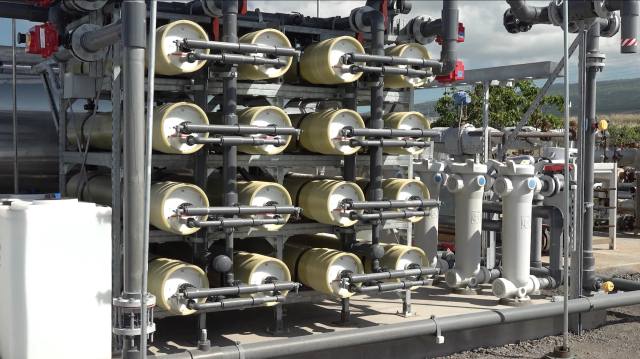
How the Treatment System Works
Forward osmosis changes the concentration step and leaves the rest of the water train intact. Trevi combines FO or PFO with the conditioning, heat integration, polishing, and residual handling the stream requires.
- 01
Condition the feed
Screens, solids control, pH adjustment, and scale management are selected from the feed analysis and operating history.
- 02
Move and concentrate the water
An osmotic gradient draws water across the FO membrane while retained constituents concentrate in the feed. PFO extends the duty for selected brines.
- 03
Regenerate and finish
Low-grade heat separates the water from Trevi's draw solution; downstream treatment brings it to the reuse or discharge specification.

Boron and Organics
Boron may set a reuse limit. Organic loading may shape pretreatment, cleaning, advanced oxidation, or final polishing. Those decisions belong in the flowsheet.
- 01
Measure first
Identify the constituent, concentration, variability, and required limit before selecting a removal step.
- 02
Match the treatment
Trevi integrates FO/PFO with dedicated polishing or advanced oxidation where the chemistry requires it.
- 03
Verify the complete train
At Masdar, the documented Trevi desalination train used downstream RO to ensure sufficient boron removal. Specify and test the whole system.
Five Steps From Sample to Full Scale
The flowsheet changes by stream. The discipline does not.
- 01
Characterize
We characterize organic load, TOC/COD/BOD, and dissolved metals alongside the core panel. Industrial chemistry varies by batch and process step, not just by source.
- 02
Define
Agree on the recovered-water specification, concentrate target, duty cycle, and residual route. Reuse and discharge projects finish at different water quality.
- 03
Configure
Select pretreatment, FO or PFO concentration, draw regeneration, heat recovery, polishing, and controls around the feed and facility.
- 04
Pilot
Bench or mobile testing measures stable operation, water quality, concentration, cleaning response, and energy under representative conditions.
- 05
Scale
Translate the pilot into a site design with defined operating limits, utilities, and performance criteria.
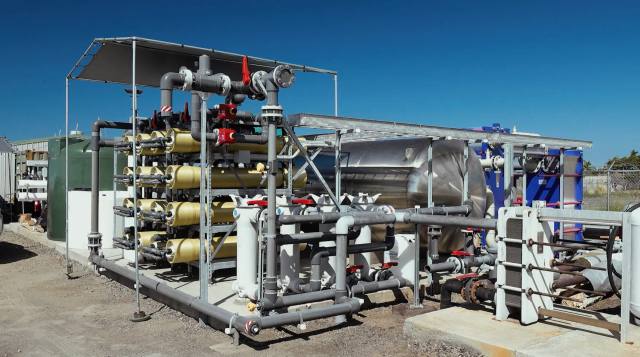
Field Evidence: California and Masdar
Trevi's California work runs from a difficult concentrate problem to a field test: establish the use case, bring the train to the water, measure the complete system before scale-up.
- California · NAWI mobile program
- NAWI selected Global Water Innovations and Trevi to demonstrate high-recovery treatment across five California sites with a 25 m³/day FO/PFO mobile unit on varied RO brines from agricultural, industrial, and oil-and-gas wastewater. The peer-reviewed test report (Webley, Greene & Easter, AJRSP, 2026) reports 84.2–98.4% water recovery across the five demonstrations.
- Orange County · CEC / OCWD
- The California Energy Commission supported a $1.7M Trevi demonstration at Orange County Water District: further concentrate RO brine, increase water yield, reduce brine volume, and use waste heat for draw regeneration.
- Treatment-train evidence · Masdar
- Masdar's published Trevi flowsheet paired FO and draw regeneration with nanofiltration, RO boron polishing, and remineralization in one integrated design.
Recovery, water quality, energy, and cost are established on the actual stream and full treatment train.
Define a Test for Your StreamBring the chemistry, flow, water target, heat profile, and current disposal route. We'll define the next test.