
Seawater & Brackish
desalinationTrevi turns seawater and brackish sources into application-ready water with a low-pressure forward-osmosis loop regenerated by low-grade heat. Start with the water you have and the heat your site can put to work.
Source Water, Heat, and Product Specification
A seawater intake, a brackish well, and an industrial saline stream are three different projects. Salinity, scaling ions, organics, temperature, seasonal variation, and the required product quality shape the treatment train.
Trevi adds one question: what usable heat is already on site? Industrial waste heat, solar thermal, or another low-temperature source can regenerate the draw solution and change the project's electrical-energy profile.
- Feed
- Seawater · Brackish groundwater · Saline process water
- Design inputs
- Chemistry · Flow · Temperature · Water specification
- Thermal inputs
- Waste heat · Solar thermal · Site-specific sources
- Outputs
- Specified product water · Managed concentrate
Design basis: feed chemistry, flow, temperature, product specification, and available heat.
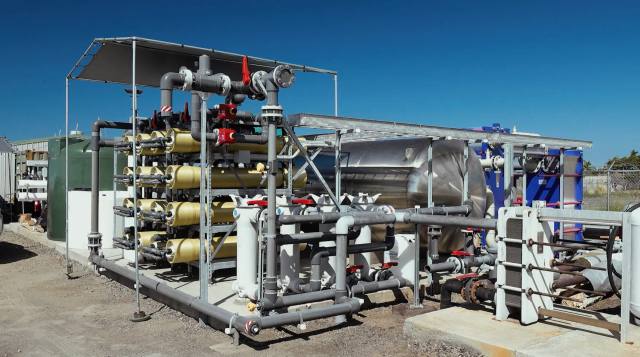
How Heat-Regenerated Forward Osmosis Works
Forward osmosis changes how water crosses the membrane. The project still has to condition the feed, regenerate the draw, polish the product, and manage the concentrate. Trevi engineers those steps as one system.
- 01
Low-pressure transfer
An osmotic gradient draws water across the FO membrane; salts and other retained constituents stay in the feed stream.
- 02
Thermal regeneration
Low-temperature heat separates the water from Trevi's draw solution; the concentrated draw returns to the loop.
- 03
Water to specification
Filtration, polishing, and remineralization are selected for the end use, from process and irrigation supply to a defined potable-water standard.
Five Steps From Feed Water to Product Water
Every project moves through the same five decisions.
- 01
Characterize
We characterize the full saline panel: salinity, density, boron, and bromide alongside major ions, because TDS alone won't reveal the counter-ion load.
- 02
Condition
Select intake and pretreatment around the real source water for stable membrane operation.
- 03
Transfer
Feed water meets Trevi's draw solution across the FO membrane; water crosses on the osmotic gradient while salts concentrate in the feed stream.
- 04
Regenerate
Low-temperature heat separates product water from the draw. Heat recovery and draw recycle close the loop.
- 05
Finish
Polish and remineralize to specification. Route the concentrate to discharge, further concentration, or resource recovery.
Energy Integration and Heat Sources
Trevi is strongest where low-grade heat is available or can be supplied cost-effectively. Heat source, duty cycle, temperature, storage, and backup are modeled with the water train, never added after it.
- 01
Industrial waste heat
Recoverable heat from power generation, data infrastructure, and industrial processes can serve draw regeneration.
- 02
Solar thermal
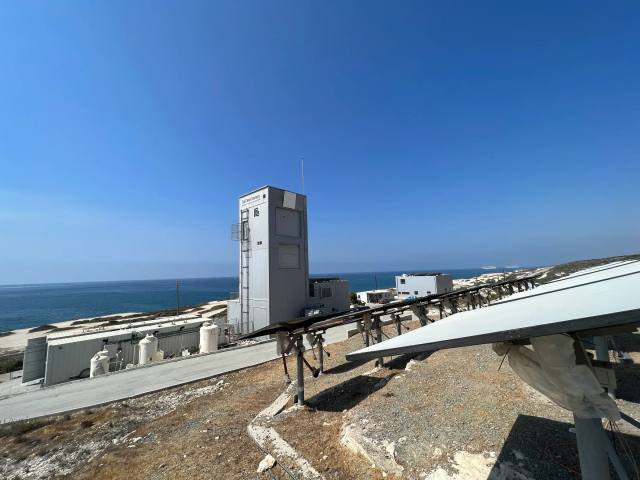
DOE/NELHA in Hawaii and the PROTEAS demonstration in Cyprus show FO coupled to solar-thermal infrastructure under different site conditions.
- 03
Hybrid site supply
Where one source cannot cover every hour, storage or a supplemental thermal source covers the gap.
Field Evidence Across Four Seawater Environments
Trevi's desalination work spans solar-thermal integration, high-salinity Gulf seawater, potable-water testing, and demanding coastal pilots. Each result stays attached to its site and test boundary.
- Hawaii · DOE / NELHA
- 500 m³/day solar-thermal seawater demonstration. DOE reported a fully integrated system at commercially relevant scale, with product water of similar quality to conventional RO.
- Ghantoot, UAE · Masdar
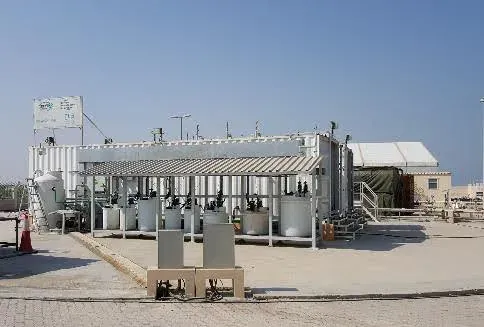
- 50 m³/day FO pilot on Arabian Gulf seawater. Masdar measured 1.47 kWh/m³ electrical plus 134 kJ/kg low-temperature heat at a 1.1 m³/h test flow; product water met Abu Dhabi potable-water standards.
- Cyprus · PROTEAS
- Trevi's 50 m³/day FO demonstration at the Cyprus Institute's solar-thermal research facility. Power and water are generated from the same solar array, with ultra low CO2 emission.
- Kuwait · KISR
- Peer-reviewed assessment of a Trevi-built 10 m³/day pilot using Arabian Gulf beach-well seawater at KISR's Desalination Research Plant.
Recovery, energy, water quality, and availability depend on the feed and the final system design.
Review Your Feed With TreviBring the chemistry, flow, water target, and heat profile. We'll define the next test.