
Mining & Tailings
waterTrevi applies forward osmosis and pressurized forward osmosis to pretreated mine, contact, and tailings-derived waters, recovering a water stream for polishing while shrinking the residual left to manage.
Mine Water Streams We Treat
Thickeners and filters recover bulk water from tailings solids; site systems collect contact water, seepage, and process streams with different chemistries. The next constraint may be solids, dissolved salts, scaling ions, reagents, acidity, metals, or the quality required for reuse or discharge.
Trevi's stage begins once a representative stream and inlet condition are defined: FO/PFO as the dissolved-solids concentration and water-recovery step inside the wider mine-water flowsheet.
- Bulk dewatering
- Thickeners, clarification, filtration, and solids handling prepare a defined liquid stream
- Trevi FO / PFO
- Move water across the membrane; dissolved constituents stay in a more concentrated residual
- Recovered water
- Polish and validate to the agreed process-reuse or discharge specification
- Residual route
- Send the reduced stream to further concentration, containment, disposal, or recovery
Trevi does not replace tailings thickening, filtration, transport, dam-safety engineering, or sitewide water management.
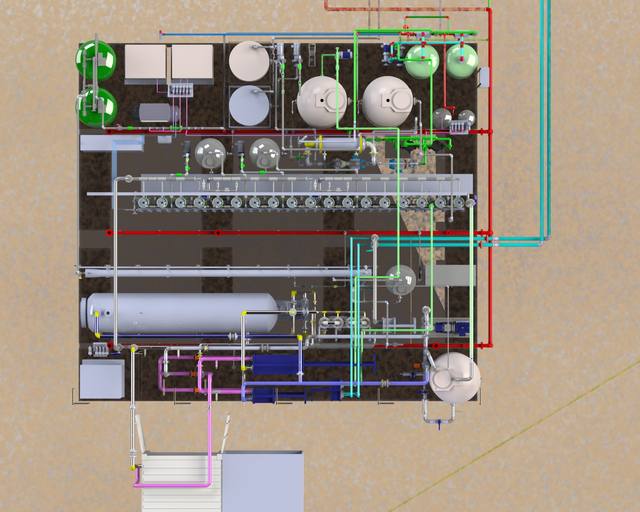
Designing Around the Site Water Balance
A viable project connects four boundaries: the stream available, the water the operation can reuse, the heat the site can supply, and the residual it can manage. Trevi starts there.
- 01
Inventory the water
Map source, flow, temperature, seasonality, current treatment, and the site's reuse and discharge balance.
- 02
Characterize the feed
We characterize trace metals, sulfate, and scale-forming species specific to the ore body, loads a generic panel won't capture.
- 03
Define the return-water target
Set the quality required for process reuse, dust control, discharge, or further treatment.
- 04
Close the residual and energy paths
Identify available waste, geothermal, or solar heat and define where the concentrated residual will go.

Water Recovery and Mineral Recovery
Water recovery moves water out of a conditioned stream and leaves the dissolved constituents in less liquid. If that residual holds minerals of interest, its value is established in a separate program. Special Project Delivery takes the mineral-recovery handoff into critical-resource infrastructure development.
- 01
Water recovery asks one question
Can the site produce and use a defined water stream while managing a smaller residual?
- 02
Mineral recovery asks another
Are target minerals present at useful concentrations relative to competing ions and downstream separation requirements?
- 03
Extraction completes the flowsheet
Selective extraction, purification, yield, and economics determine whether a concentrated stream becomes a product. Trevi's DDX solvent-extraction draw solutions, recovered using low-grade heat, can serve that step.
Four Steps From Assay to Returned Water
Each step narrows the operating envelope before scale.
- 01
Characterize
Confirm the full assay, flow and temperature profile, variability, water balance, endpoint, and residual constraint.
- 02
Clarify and condition
Set solids removal, pretreatment, pH and scaling controls, and the inlet specification for a stable test.
- 03
Transfer and regenerate
FO or PFO transfers water into Trevi's draw solution; heat separates the water and returns the draw to the loop.
- 04
Polish, return, and route
Validate the recovered water against its specification and direct the residual to its downstream step.
Relevant Equipment Experience
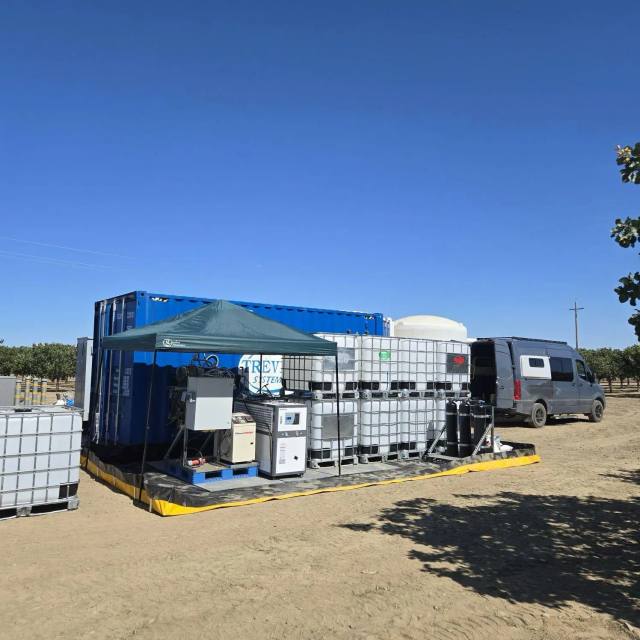
Trevi ran a 25 m³/day mobile FO/PFO brine-concentration platform across five California sites under the National Alliance for Water Innovation, concentrating reverse-osmosis brine, agricultural drainage, and oil-and-gas wastewater on a single skid.
Trevi is also under contract for mining-industry water concentration and resource recovery. Client, stream, and performance details are not public.
On that contract, the mine requires 85% water recovery from its tailings pond with ultra-low chlorides in the finished water. With a 240 m³/hr reject stream and very high hardness, the duty suits Trevi's SaltVault™ brine-concentration platform. The site and operator remain undisclosed.
- 25 m³/day
- NAWI mobile brine-concentration platform, run across five California sites
- Feed disclosure
- Proprietary; chemistry and mining relevance are not disclosed
This describes the platform, not a mining-performance claim: recovery, rejection, energy, and residual behavior are established per feed and flowsheet.
Define a Site-Specific TestBring the assay, water balance, heat profile, and return-water target. We'll define the next test.